How AI-generated, custom rap tracks helped boost engagement on sports videos
Bryan Erdy, Defender Network,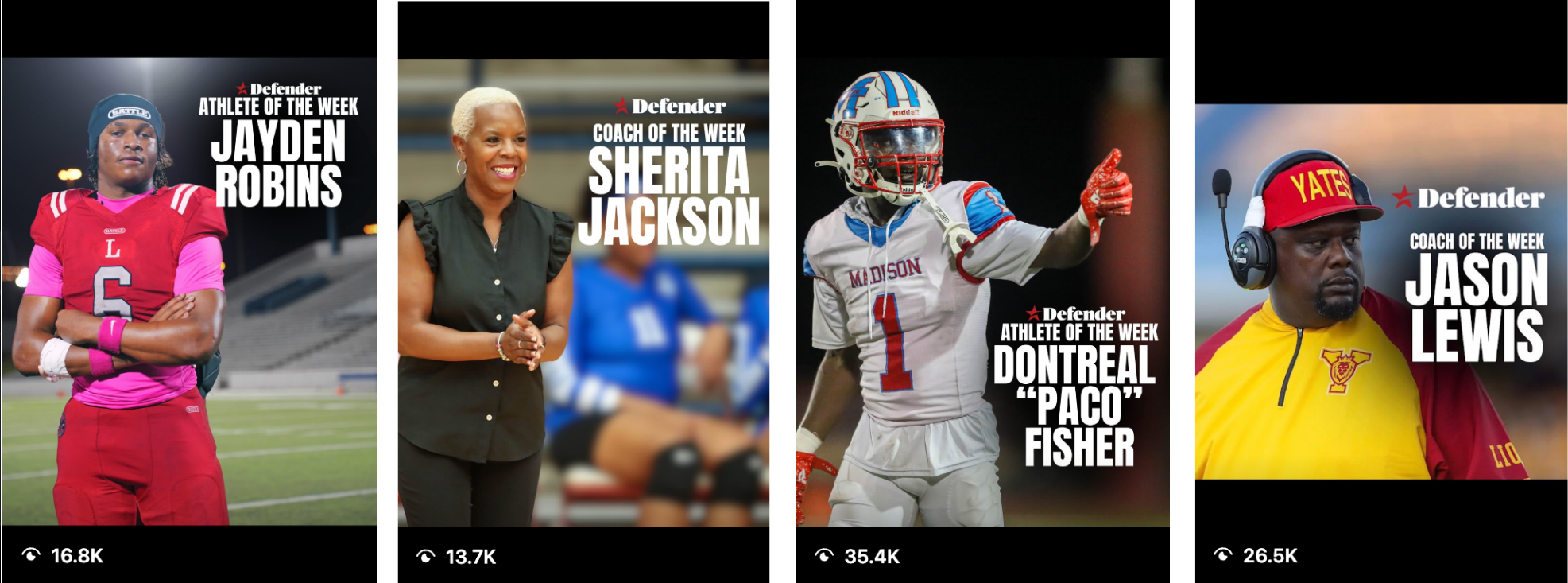
Screenshots of Defender Network Instagram videos
The Houston Defender uses a tool that turns text prompts into custom rap tracks for high school sports videos, and now young athletes and coaches ask to be featured.This is a series on Better News highlighting replicable strategies shared at the American Press Institute’s Local News Summits, highly participatory, invitation-based convenings that provide a welcoming and collaborative space for local media decision-makers and experts to think boldly.
This win comes from Bryan Erdy, video producer at the Defender Network, who shared his work at API’s Local News Summit on Youth Trust and Civic Resilience.
The Houston Defender is a Black-owned independent news organization serving the Houston, Texas, community. As video manager, I oversee aspects of our local high school sports coverage — an effort to shine a light on young athletes and coaches. I produce game highlights, weekly Athlete of the Week features and Coach of the Week spotlights, all shared across social.
The challenge we kept running into was simple but stubborn: How do you get teenagers to care about a local news outlet? How do you earn their attention, their time and their trust in a highly competitive landscape while competing with TikTok, YouTube Shorts and everything else on their phones? We needed to meet them where they were — culturally and creatively. By integrating AI-generated, custom rap music into our video content, we found a surprisingly effective answer. What started as an experiment became a direct pipeline for youth engagement.
The problem we were looking to solve
Local news organizations across the country are struggling to connect with younger audiences. For us at the Houston Defender, that challenge was especially visible in our high school sports coverage. We were sending crews to games, shooting highlights, editing Athlete of the Week and Coach of the Week videos — but the numbers told a hard truth. Videos were getting 15-20 views on YouTube. Coaches were hard to pin down for interviews. Student athletes weren’t lining up to talk to the local news.
The background music we used didn’t help. Generic, royalty-free tracks felt disconnected from our audience — Black teenagers in Houston who have a very specific and vibrant musical culture. The content was good. The presentation felt flat.
This is a problem the broader local news industry knows well. Younger audiences don’t have the same relationship with local news that older generations do. Trust must be earned through relevance, and relevance means speaking someone’s language — sometimes literally. For a Black-owned outlet covering a predominantly Black community of young athletes, the disconnect between our production style and our audience’s cultural identity was a real barrier to engagement.
We needed a way to make our coverage feel like it belonged to these kids — not just coverage about them, but content they felt proud to share, that reflected who they are and what they love.
How we did it
The solution came from experimenting with an AI music generation tool called Suno, which creates original songs from text prompts. Our technology adviser through the Knight x LMA BloomLab heard one of the early experiments and suggested we use it to make custom music for every Athlete of the Week and Coach of the Week video — and eventually for game highlight reels as well.
Here is how the process works:
- Custom song creation for every feature. For each Athlete of the Week or Coach of the Week video, I generate an original AI rap song using Suno that includes the player’s name, nickname, jersey number, position and any other relevant details. Every song is unique to that individual.
- Prompt crafting matters. The more specific the prompt, the better the result. We pull details from game stats, social media and post-game conversations to make each song feel personal and authentic.
- Integration into the edit. The custom track is woven into the video alongside game highlights, still photos, posed images and lower-third graphics. The music drives the energy of the edit.
- Distribution on social media and YouTube. Videos are posted across the Defender Network’s Instagram and YouTube platforms, where they are easily shareable by the athletes, their families and their teammates.
- Lean production workflow. The process is primarily handled by a single video manager, making it scalable even for small newsrooms with limited staff and budget. Suno operates on a subscription model, keeping costs low.
View this post on Instagram
Our impact
The results were immediate and dramatic, with our most substantial growth happening on Instagram.
- Instagram engagement has transformed completely. Three years ago, a Coach of the Week post would typically earn around 80 likes, one or two comments and virtually no shares. On Feb. 18, our Coach of the Week feature on Coach Greg Wise — the legendary head boys basketball coach at Jack Yates High School and one of the winningest coaches in Texas high school basketball history, who celebrated the milestone of 1,000 career wins — earned 359 likes, 15 comments, 36 reshares and 57 direct sends. That’s not an incremental improvement. That’s a fundamentally different level of community engagement.
- YouTube views jumped from 15–20 per video to approximately 150 per video. That’s roughly a 10x increase — showing the format resonates across platforms.
- Athletes and coaches began seeking us out. The question shifted from us asking, “Can you please give us five minutes?” to them asking, “When is my video dropping? Where’s my rap song?”
- Organic sharing has extended our reach far beyond our existing audience. Instagram’s share-and-repost culture makes that distribution especially powerful, with athletes, coaches, families, teammates and classmates all spreading the content.
- This strategy directly led to the monetization of both the Houston Defender’s YouTube channel and Instagram account. The surge in views, watch time and subscribers driven by the custom AI rap videos pushed us over the thresholds required by both platforms to qualify for monetization — a milestone we had been working toward and that now creates a sustainable new revenue stream for our independent, Black-owned newsroom.
- We have built a genuine relationship with Houston’s youth sports community. Young people who may never have thought about local news now associate the Defender with content that celebrates them, reflects their culture and makes them feel seen.
How to put this into practice for yourself
You don’t need a massive budget or a large team to try this. What you need is a willingness to experiment and a genuine curiosity about what your audience loves.
- Start with what you already cover. Do you have a recurring feature — an athlete spotlight, a student of the month, a community hero series? That’s your entry point. Custom, personalized content works best when it’s attached to something you’re already producing consistently.
- Learn your audience’s cultural language. What kind of music is popular with the audience you are trying to engage? What tone, style and references will make them feel like this was made for them? Spend time on their social channels. Ask them directly. The goal is resonance, not just content.
- Experiment with AI music tools like Suno. You don’t need to be a musician or audio engineer. Start with a simple prompt that includes a person’s name and a few details, and iterate from there. The more specific your prompt, the more personal and compelling the result. Most tools offer free tiers to test before you commit.
- Make it personal, every time. Generic content gets generic results. Including a player’s jersey number, their nickname or a shoutout to their school creates a moment of recognition that makes someone want to share. These details are what turn a video into their video.
- Let the community do the distribution for you. When someone sees themselves celebrated in content that reflects their identity and culture, they share it. Build your workflow around that reality — make it easy to tag athletes and coaches, post at times when they’re online and encourage collaborative posts.
- Track your metrics from day one. Even if your starting numbers are small, document them. The ability to show concrete before-and-after metrics — likes, shares, direct sends, views — will make the case internally for continuing and expanding the program.
View this post on Instagram